

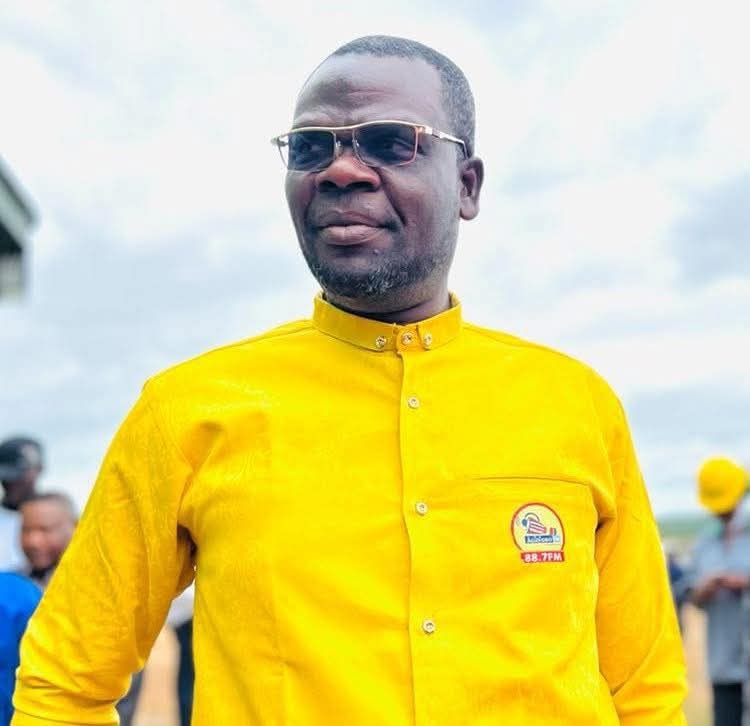
Politics has a way of recruiting unusual contenders, and sometimes the strongest entry point is not a party office, but a public bond. That is the space Alhaji Oriyomi Hamzat now occupies in Oyo, a broadcaster whose voice has become familiar enough to feel like presence, and whose name has moved beyond radio into the language of succession and ambition. He has now publicly declared his intention to run for Governor of Oyo State in 2027, under the formidable Accord Party.
Hamzat is not just “a presenter.” He is the founder of Agidigbo FM in Ibadan, a platform that is not merely a business but a civic instrument in a state where communication is power and familiarity is political currency. In Nigerian politics, many men spend years buying visibility. Some inherit it. Others build it. Hamzat’s own kind is built daily, through trust, through consistency, through the intimate routine of a voice that meets people before work, meets them in traffic, meets them in the markets, and meets them at night when the day’s noise has settled.
This is why his entry feels like a disruption. Traditional politicians often “reach the grassroots” as a campaign phase. Hamzat already lives inside the grassroots as a habit. That matters, because elections are not only about party symbols, they are also about public intimacy, who feels close, who sounds like home, who can turn sympathy into conviction, and conviction into votes.
But governorship is not awarded for popularity alone. It is a mandate to manage complexity. The Oyo voter, like the Yoruba voter generally, can enjoy your vibe and still demand competence. They can love your presence and still ask the hard question, can you govern? That is where Hamzat’s ambition must mature from influence into institution, from voice into structure. A governorship project cannot be run like a radio programme. It must be built like a coalition.
Yet there is a clear political logic to why a broadcaster can become a serious contender in a state like Oyo. The modern voter does not only follow ward meetings, he follows narratives. He follows platforms. He follows people who appear to fight for ordinary citizens and speak with the confidence of lived proximity, not elite distance. This is how outsider energy is born because citizens begin to feel politics has become a closed shop, they start searching for a key that was not manufactured by the shop owners.
Hamzat’s declaration, by itself, is not victory; it is a signal. It tells Oyo that he wants to move from being a civic presence to being a political contender. It tells party structures that the conversation has shifted. It tells career politicians that the monopoly of “who can aspire” is under pressure. And it tells the public that the 2027 race may not be a routine succession, but a contest between the familiar order and a rising alternative.
If Oriyomi Hamzat truly wants to translate the microphone into a mandate, the task ahead is simple to state and hard to execute, keep the public bond, but build the political bones. Keep the grassroots affection, but assemble statewide structure. Keep the narrative, but prepare the numbers. That is the difference between a man who is discussed and a man who is elected.
And if he gets that balance right, Oyo will not merely talk about him. Oyo will have to reckon with him. Oyo, your new Governor is coming.
Pelumi Olajengbesi writes from Osun State.
